
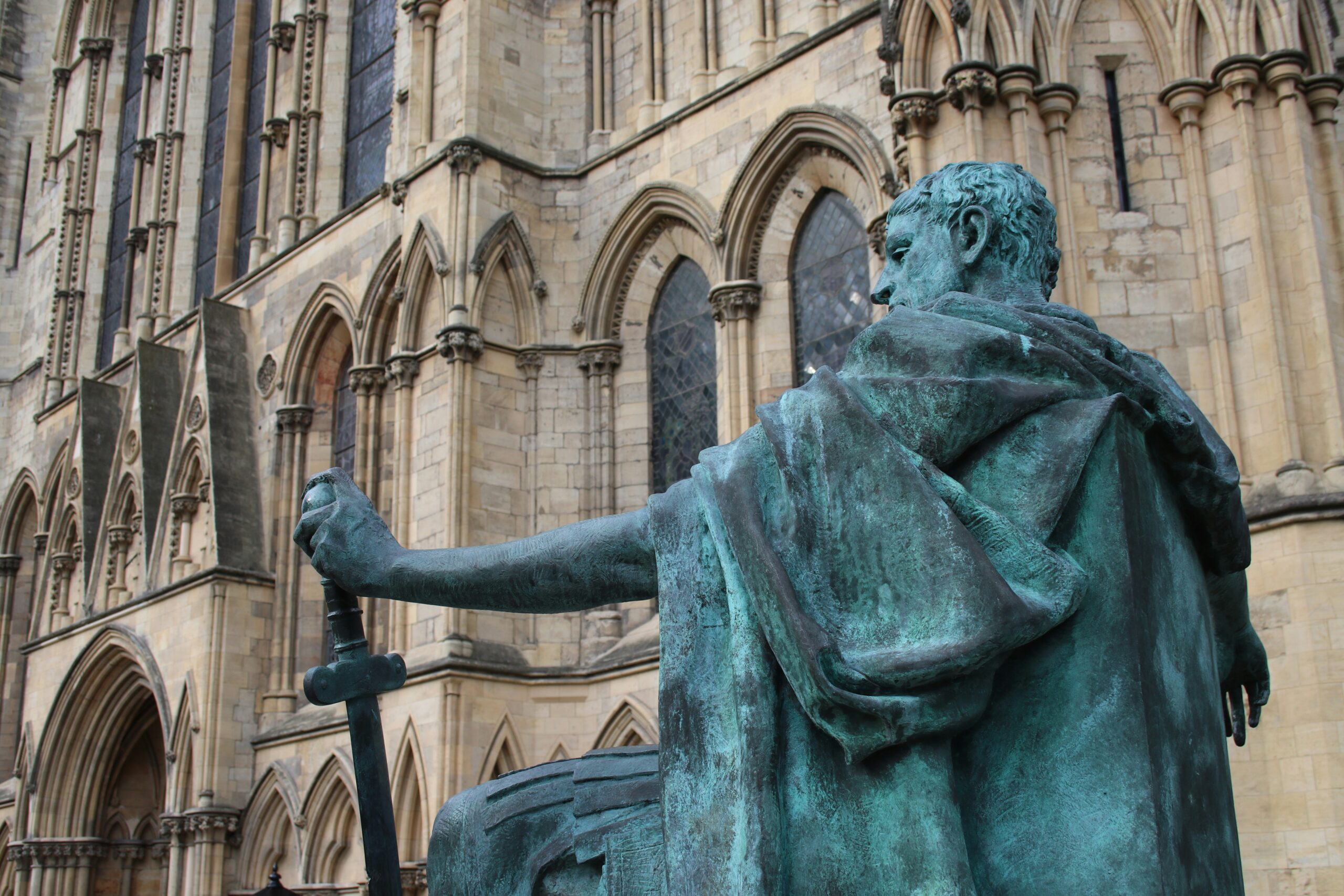
A gift from The Wife
The Wife is a great gift-giver, as evidenced by the Jacques de Molay fountain pen I wrote about a few weeks ago.
But before she gave me the fountain pen, she gave me a coin—not just any coin, but a very special coin. It’s a Constantine bronze follis, minted in Antioch between 326 and 328 A.D., during the reign of Constantine the Great. It was minted after his vision at the Milvian Bridge and after he became a Christian.
The coin has Constantine’s likeness on one side and an image of a Roman fortress on the other.
Why Constantine is a favorite
Constantine has always been on the list of those people I’d most like to meet in heaven, along with Charlemagne, St. Louis, C.S. Lewis, G.K. Chesterton, and Denzel Washington. Yes, I know, Denzel is still alive, but my chances of meeting him during this lifetime are probably not great.
Constantine has always fascinated me. He was the most powerful man in the world when he became a Jesus follower, and when he did, he stood at one of the great turning points in history. He inherited an empire shaped by centuries of paganism and persecution, then spent the rest of his reign trying to govern and reshape it according to Christian principles. There was no blueprint for doing this because no one had ever done it. History rarely gives anyone an assignment that difficult.
I admire people who receive enormous responsibility and exercise it faithfully and excellently. As I’ve written here before, I believe competence is a virtue. That is one of the principal lessons of the Parable of the Talents. Constantine did not become a monk after his conversion. He remained an emperor, asking what it meant to rule under the authority of the King of kings and do it well.
Why historians call him “the Great”
It has become fashionable today for historians, including many church historians, to blame Constantine for conflating church and state and making room for a lukewarm medieval church. But this is like blaming the U.S. Constitution for the crime rate in America. Good gifts can still be misused, particularly where the human heart is concerned.
Yet historians still refer to him as “Constantine the Great,” and the Eastern Catholic and Eastern Orthodox call him a saint. It is not simply because he was the first Christian Roman emperor.
Constantine reshaped the Roman world. He reunited a fractured empire and founded Constantinople, which would become the center of Christendom in the East. Constantinople would also become the capital city of the Byzantine Empire, the first Christian empire, and one that would last for another 1,100 years.
Exercising power for the good of the Kingdom
He also helped resolve one of the most difficult doctrinal disputes in the Arian controversy when he brought both sides together at the Council of Nicaea. Eusebius of Caeserea wrote a detailed eyewitness account of Constantine’s humility and wisdom at the council in his book, The Life of Constantine.
As I read Eusebius’s account, I came away with the distinct impression Constantine’s presence at the council helped bring about a resolution to the controversy. It wasn’t because Constantine made theological arguments that changed people’s minds. He knew that was not his role. But his presence there as the most powerful man in the world, and one who loved Jesus and His church, created the best possible environment for resolution. Great leaders know how to exercise their power to solve problems.
Very few people have altered the course of history as profoundly for the good as Constantine did. Every vocation eventually raises the same question, and that is not whether we will be pastors, missionaries, or theologians but what does it look like be a Christian in the work we’ve been given to do.
What’s in a coin?
So, when I look at my 1,700 year-old bronze follis, I do not see only an historical artifact.
I see the life of a man who understood what King Jesus expected of him in his work. I see a man who was given one of the most difficult jobs in history and performed on a level reflective of the trust his Master had placed in him.
I see Constantine the Great. GS

