
Learning the hard way
I know a little about preaching—emphasis on little. I first preached in church when I was in my late twenties. When I became an elder in my late-thirties, I began preaching regularly a few times per year.
That has continued for years with one exception, and that was when I actually pastored a church for a year. During that year, I was preaching three times per month while still working full-time as a trial lawyer. That is when I learned how difficult good preaching is.
So, I began to study the mechanics of preaching. I read a number of books and asked other pastors for advice, more out of desperation than curiosity. And here’s the thing: I actually improved.
With that, here are the four most important lessons I have learned about preaching.
1. Start with prayer
I start with prayer because I only want to preach what the Lord tells me to preach. I learned this lesson when I was pastoring.
When I preached what I wanted to preach instead of what the Lord told me to preach, it never landed. Yet, when I started with what I felt He was telling me to preach, even if I didn’t think I had any insight at first, I would either find it in preparation or it would just work when I preached it.
I quickly learned to value His anointing more than my own insight in the pulpit.
2. Find a structure that works
After much reading and experimentation in the pulpit, I finally landed on Andy Stanley. I am more of teacher than a preacher anyway. If I try to sound like T.D. Jakes it wouldn’t be authentic. Andy Stanley is more of a teacher.
Stanley uses the me/you/God/you/we structure for his messages. He starts by building tension about the point he will preach by talking from his personal experience and then extends it to the audience. He then responds to the question/problem from Scripture, applies it to the audience specifically, and to the church generally.
It works because it gets the audience invested from the beginning of the sermon and builds curiosity before he provides the answer from Scripture. This makes application the next natural step. I’m sure there are other structures that do this is well, but I know this one works.
This structure can be found in Stanley’s book, Communicating for a Change.
By having a tried and true structure, I’m always reminded to build from tension, to an answer, and ultimately to application.
3. Abandon notes but not structure
I used to work from an outline and stuck closely to it. One Sunday after reading a book about abandoning notes and “trusting the Holy Spirit,” I filled myself up all week with information and Bible study and then just got up with no notes and preached as it came to me. It was a disaster.
Then I went to the other extreme. I plagiarized a great Andy Stanley sermon. Seriously. I memorized it beat by beat and then preached it. That one really worked, but I knew I couldn’t just memorize other people’s sermons every week.
The solution for me was learning the Method of Loci, an ancient memorization technique used by Cicero and others to memorize lengthy speeches. You can find it explained in the book, Moonwalking with Einstein, by Joshua Foer.
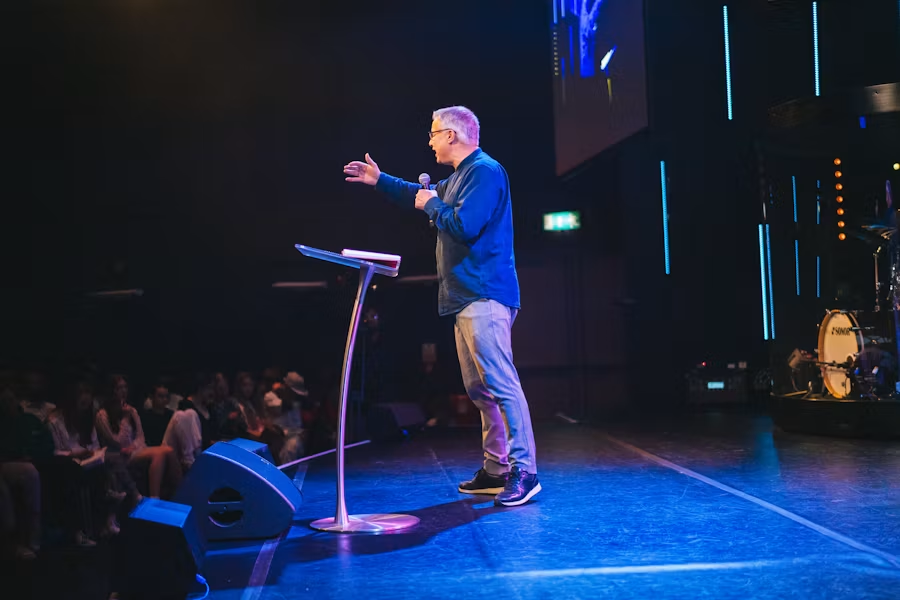
So, now I have the best of both worlds—I prepare a very well thought-out outline and then embed it in my visual memory using the Method of Loci. When I get up on stage, I carry no notes. I move the pulpit aside, and I begin.
My delivery is dramatically better. The sermon feels authentic because I’m not reading or referring to notes, but what I’m preaching is very much prepared and thought out in terms of organization, sequencing, and word choice. Because I’m not constantly looking back at my notes for what comes next, it leaves room for me to observe the audience response and hear the Holy Spirit in real time.
4. A single point
Once I get the idea of what He wants me to preach, I refine it down to a one sentence takeaway. A single point.
The three point sermon is a waste of two points. Nobody ever remembers more than one. If you don’t believe me, just ask your friends next Sunday after the sermon how many points they remember. Most can’t even remember one. Better to spend your time making the single point so that everyone remembers it.
Once you have your single point, it helps direct everything else you prepare to serve that single goal. It becomes easier to leave out that interesting point you wanted to include because you thought it was insightful because now you realize it distracts from your goal.
By limiting yourself to a single point, it allows you to stay focused. By focusing on a single point, it forces you to go deep. And by preaching without notes, it helps you to preach from the heart in a more interactive way with the Holy Spirit and your audience.
I’m still not a great preacher and probably never will be. But I do want to be faithful to be the best I can be when I am asked to preach. That is all we can ever hope for. GS

