
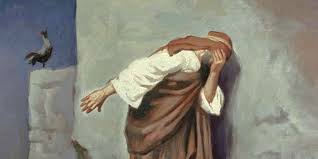
To understand how Peter’s betrayal broke his self-sufficiency and the real meaning of Jesus’ command in John 21 to Peter to “Feed My Sheep,” we need to start with a conversation between Peter and Jesus that occurred before Peter’s betrayal.
Peter’s self-sufficiency demonstrated
The conversation happened at the last supper:
“Simon, Simon, behold, Satan demanded to have you, that he might sift you like wheat, but I have prayed for you that your faith may not fail. And when you have turned again, strengthen your brothers.” Peter said to him, “Lord, I am ready to go with you both to prison and to death.” Jesus said, “I tell you, Peter, the rooster will not crow this day, until you deny three times that you know me.”
Luke 22:31–34
When Jesus told Peter that Satan had demanded permission to sift him like wheat, it likely provoked a vivid, violent image in Peter’s mind. Today, when we hear the word “sift” we think of sifting through papers or perhaps sifting flour. Not so for any first century Israelite.
Sifting wheat in first century Israel was a two step process. First was beating the bundle of wheat with a stick to break the outer shell (chaff) off the kernel. Then came the violent shaking to separate the chaff, straw, and dust from the kernels of wheat. Jesus was telling Peter that Satan was going to be beating on him and violently shaking him—so much so that Jesus was going to have to pray that Peter would survive it without losing his faith
Peter didn’t doubt Jesus’ warning about what was going to happen; instead Peter suggested Jesus need not be concerned because he would never waver. Few statements demonstrate more clearly Peter’s fleshly confidence, his self-sufficiency. In short, Peter was more confident in his strength than in his dependence on God.
Then Jesus gives Peter the more devastating news—that he would be shown not to be the strong, self-sufficient leader he thought he was. For Peter, this would have struck at the very core of who he was. In a very real sense, Jesus was telling Peter that Peter was not the man he thought he was, and he would be finding that out very soon. Such are the makings of an identity crises.
The gentleness of Jesus in breaking Peter’s self-suffiency
What Peter didn’t understand at the time—what we all often fail to understand in the moment — is that the very things on which we base our identity are often the shell the Lord wants to break so that who He has called us to be can shine forth.
In addition, when Jesus told Peter about the sifting to come, He called him by his given name, “Simon”; when Jesus gave Peter the really devastating news that Peter was not the man he thought he was, he called him, “Peter.”
“Peter” was a name Jesus had given him, a name that meant “the rock.” So, in the same breath that Jesus told Peter he was not the man he thought he was, he was reminding Peter that through the beating and shaking he was becoming the man Jesus was calling him to be.
We all know what happens next. In a short series of interactions, Peter denies three times that he knows Jesus. Jesus turns and looks at Peter, and Peter went out and “wept bitterly.” (Luke 22:61-62). Peter’s self-sufficiency was broken. He would never be the same.
Experience is a harsh teacher but often a necessary one. Few things more clearly demonstrate to us the delta between who we think we are and who we really are than our failures.
It would have been easier if Jesus could have just told Peter, “You are self-sufficient, and you need to stop it.” But some things are best learned through experience. It is reassuring to know, though, that in the midst of a harsh reality Jesus is there reminding us of who He has called us to be.
The meaning of “Feed My Sheep”
After His resurrection, Jesus appears to the disciples on the beach, and they have breakfast together.
After breakfast, Jesus asks Peter three times whether Peter loves Him.
The first time, Jesus asks Peter “do you love Me more than these?” The pre-broken Peter might have answered, “Yes, I am willing to die for you,” or “Yes, I love you more than these others.” Previously Peter had told Jesus, “Even if all fall away, I won’t.”
This time, Peter’s answer is no longer rooted in his self-sufficiency. Instead, Peter answers, “Yes, Lord; You know that I love You.” There is no response to the “more than these” part of the question. Peter doesn’t know if he loves Jesus more than the others, and to say he did would be an expression of pride. Peter has very little pride left at this point. He only knows that he loves Jesus, and that Jesus must know that. Jesus’ then says, “Tend My lambs,” which is an affirmation that He is restoring Peter and affirming him as a leader.
Jesus would ask Peter twice more, “. . . do you love Me?” Upon Peter’s affirmations, “Lord You know that I love You,” and “You know all things; You that I love You,” Jesus says, “Shepherd My sheep,” and “Tend My sheep.” Lambs represent new or spiritually immature believers and “sheep” mature believers, and all need to be fed, led, and guided.
Peter’s answers demonstrated his humility and love for Jesus, which are the two foundations of spiritual leadership. But it all started with Peter’s failure, which the Lord used to make Peter into the man He needed to be to be a leader. GS

