

Imagine a castle, perhaps Balmoral.
Then connect that building to ten others of similar size, separated by the occasional pool or fountain and spread it out over three hundred acres in the Italian countryside, and you will have an idea of the grandeur of Hadrian’s Villa.
Lest I be accused of false advertising, let me say that Hadrian’s Villa is only 18 miles from Rome. Where I live, 18 miles from the city center is still the city. The reality is we had been to Rome three times, and I had written about it here. Besides, part of the challenge of this travel devotional is mining Christian history out of every stop. Rome is a layup. Tivoli is a three pointer with a hand in your face.
Couple that with a persistent 90-minute rain, and me, your intrepid tour guide, without an umbrella, and now you have an adventure. Fortunately, the sun emerged for the last thirty minutes of our tour of this UNESCO site, which was just enough time to dry us off for lunch.
Hadrian’s Villa – How much is enough?
Today there are only ruins at Hadrian’s Villa. We walked from the ruins of one structure to another. One had three tall walls, with part of the high domed roof still intact. Others had only parts of exterior and interior walls. Some were nothing more than foundation and a few columns.


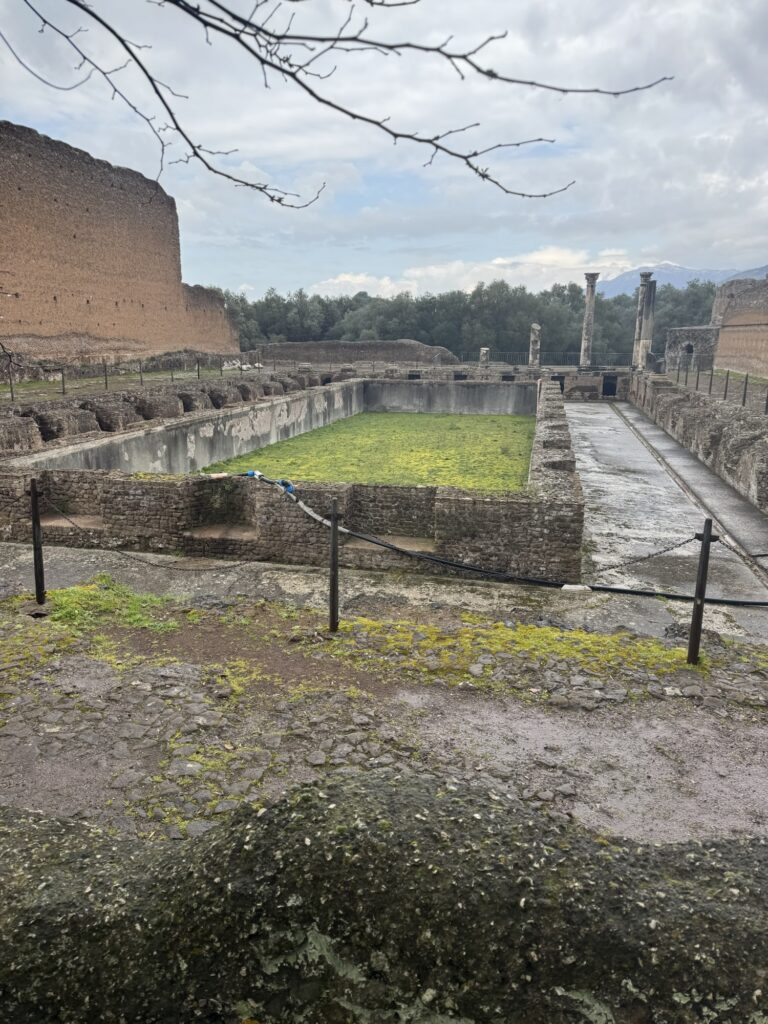
In one part of the property there was a long rectangular pool large enough to hold hundreds of swimmers. Today it held only green still water, with barely a ripple.
In a higher place on the property, there was a smaller pool with baths, unused for more than a millennium.
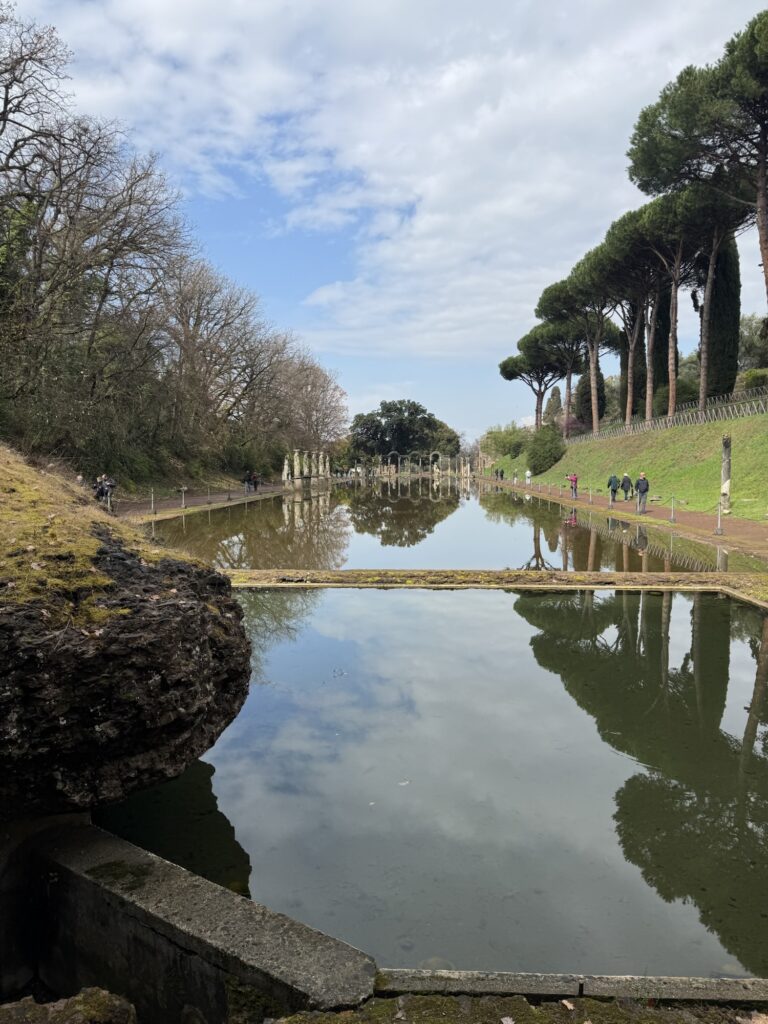
We walked for more than two hours, moving from one place to another. It was all built for one man, but a whole town could have lived there. Now no one lives there.
At some point you stop asking, “How did he build this?” And you start asking, “Why did he need it?”
What we learned about the church
Second century Christians had little reason to criticize Emperor Hadrian. Hadrian ordered that Christians should be left alone unless they committed a crime—a change from the intensifying persecution of Domitian, some 40 years prior.
Hadrian died in 138 A.D. He was succeeded by Antoninus Pius, and then Marcus Aurelius in 161 A.D. Marcus Aurelius proved far worse for the Christians. He allowed persecution to resume, and did nothing to stop it. Some of the famous martyrs we still talk about today left this world from places like Rome, Lyon, and Smyrna during the reign of Marcus Aurelius.
And yet, Christianity continued to spread throughout the Roman Empire during the reigns of Domitian and Marcus Aurelius. I’m sure Christians preferred Hadrian over Domitian or Marcus Aurelius, but who sat on the throne was largely irrelevant to the expansion of the kingdom of God.
Jesus said:
I will build my church and the gates of hell shall not prevail against it. — Matthew 16:18
The success of the kingdom of God is not dependent upon our government’s policies or politics; its success depends only on the will of its King and the faithfulness of His followers.
Seeing Hadrian’s palace and being reminded of these things certainly puts polarizing politics and contentious culture wars back home in perspective.
I’m not saying public policy and culture are not worth fighting for—I’ve volunteered my legal services to Christian public policy efforts, and I believe those fights are worth having. But remembering how the early church grew under a hostile government and culture leads me to an inescapable conclusion.
Policy is helpful.
Culture is helpful.
But neither are essential.
Until tomorrow. GS

