

The two most famous landings on Malta occurred 1,500 years apart. The first was the Apostle Paul’s shipwreck in 60 A.D. The second was the Ottoman Turk’s invasion in 1565 A.D.
The Knights of Malta
Yesterday’s tour was all about the first landing. Today was about Jean de Valette and the Knights of Malta.
Valette was the Grandmaster of the Knights of the Order of St. John (the Baptist), also known as the Knights of Malta. The order was formed by monks to provide care to pilgrims traveling to the Holy Land during the early 12th century. When Muslims began killing Christian pilgrims, the monks took up the sword to defend them.
Imagine a cross between Mother Teresa and a Navy SEAL. Fiercely devoted to serving and fully trained for battle—that was the Maltese knight.
These monks were celibate and lived according to eight virtues—faith, truth, repentance, humility, justice, mercy, sincerity, and courage—marked by the eight-pointed cross they wore, known today as the Maltese cross.
When the Holy Land was lost to the Muslims, the knights retreated to Cyprus and then Rhodes, where they were forced to leave by the attacking Ottomans in 1530. They then came to Malta.
The Great Siege of Malta
Malta was the gateway to the Western Mediterranean. Understanding its importance, in 1565 Suleyman the Magnificent sent 40,000 men to take the island in what would become known as the Great Siege of Malta.
Valette led the defense of Malta during the siege. History does not remember Valette’s face, but it cannot forget his resolve, which inspired 700 Christian knights, leading less than 9,000 men, to hold off 40,000 invading Muslim soldiers.

The Ottomans attacked, and the line nearly broke. They attacked again, and it bent further. A retreat looked certain until the defenders looked to Valette and held.
Later in the battle, boats were still ready in case the knights chose to retreat. Valette destroyed the boats. When the men abandoned the thought of saving themselves they found the strength to fight on.
As they fought on, Christian reinforcements raced from Sicily to Malta. When the Christians finally streamed ashore, the Ottomans abandoned Malta and never returned.
Our challenge
Jesus calls us to destroy our boats. He said, “unless a grain of wheat falls to the earth and dies, it remains alone, but if it dies it produces much fruit.” John 12:24. Like Valette with his men on Malta, Jesus calls us to abandon our desires for God’s desires.
After the siege of Malta, Valette commissioned what would come to be called Valletta, a walled city that sits so high above the pier, an elevator carries you from the pier up 60 feet to the town.
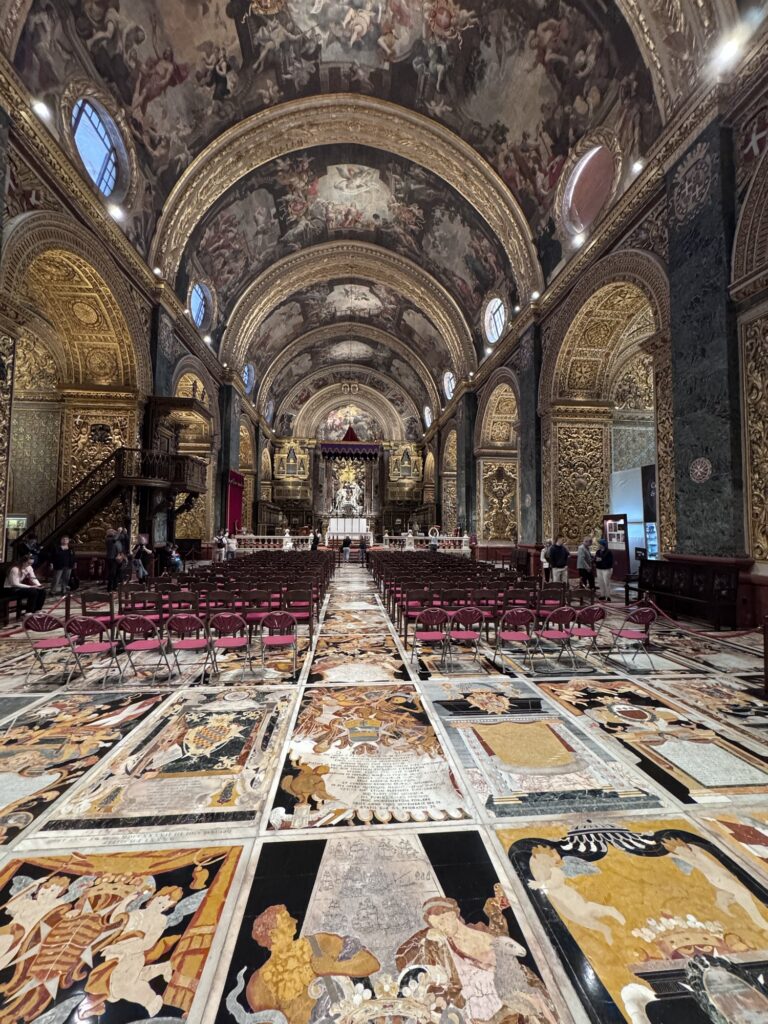
We only had the morning, so I made my first stop at the Co-cathedral of St. John, the church of Valette and the knights. The church is ordinary on the outside, but ornate on the inside—like Valette, who is entombed in the crypt beneath the altar.

When I entered the church, I overwhelmed by the gold baroque walls and the Sistine-Chapel ceiling. Then I looked down.
The floor of the cathedral consists of the tombs of 400 knights of Malta. Each is a unique creation of black, gold, and white marble—monuments to lives well-lived. For generations, these tombs have reminded those who enter this cathedral of their sacrifice. It’s hard to be forgotten when you are seen every Sunday.
After the cathedral, I walked the15 minutes to the end of town and Fort St. Elmo, where the knights held out against the Ottomans. The Ottomans thought they would take the fort in a day or two. The knights held out for a month. That extra time cost the knights their lives but purchased the salvation of the island.
Those knights would not live to see the victory their sacrifice secured, but we can. We are still talking about it nearly 500 years later.
And that is because they were willing to give their lives for something greater than themselves.
Are we?
Until tomorrow. GS

