
The strait and the rock
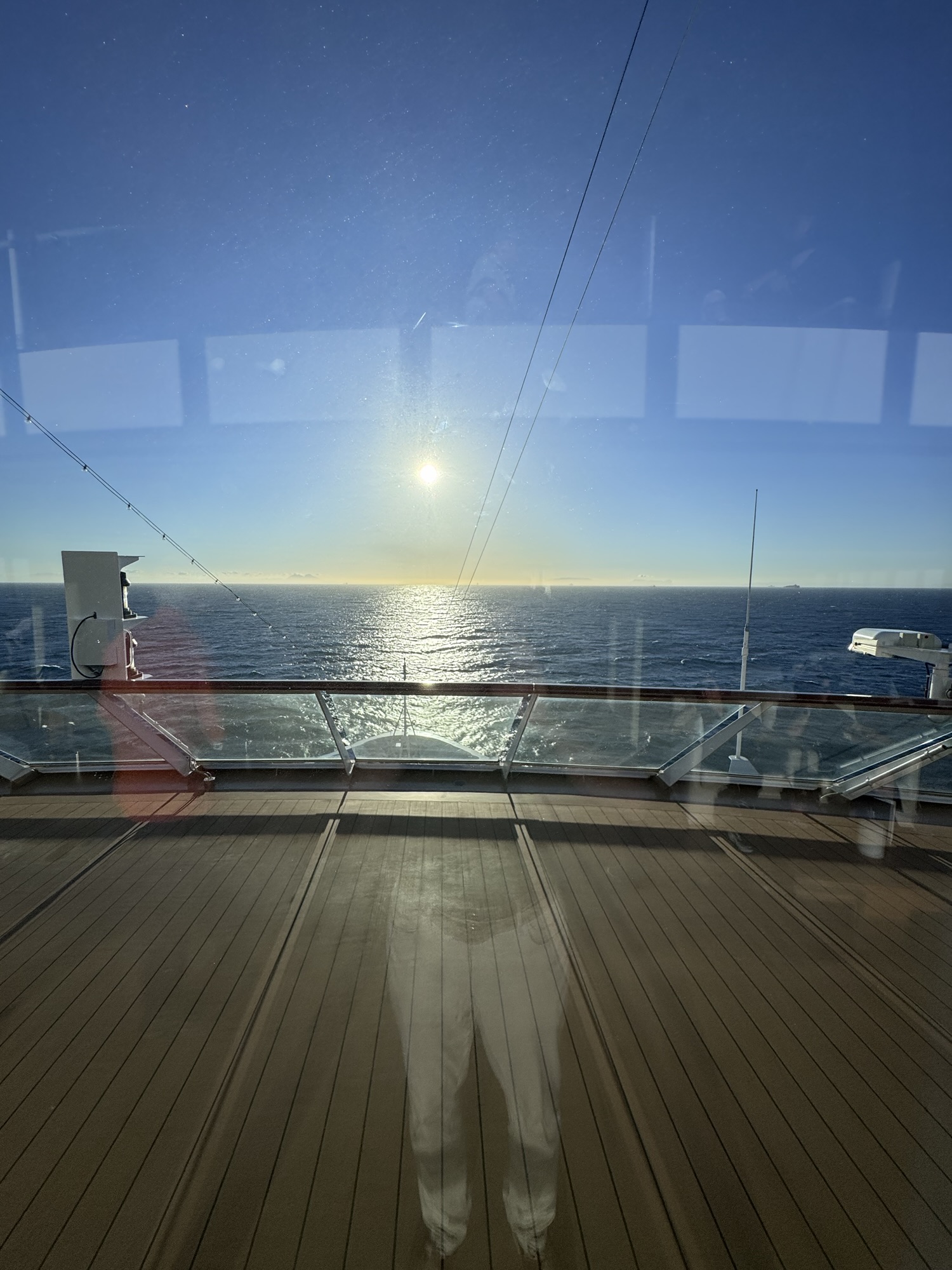
I stood on bow of the ship leaning against the rail as I watched the strait narrow into on ocean canal, only this canal was between two continents.
The great granite guardian of the strait stood ahead and to the right, and as we passed under its watchful eye with the sun shining on its sheer face, I felt I could reach out and touch it. Gibraltar—gateway to the Atlantic!

Okay. I made all that up. It wasn’t like that at all. The Rock of Gibraltar looked nothing like the pictures I’d seen.
We approached at dusk and we were never closer than six or seven miles away. It looked like a small volcano in the distance, and the clouds like a plume of smoke billowing out of its cone.

The strait is wider than I imagined—14 miles in the east, where we entered. That is where the Rock is.
For some reason, I thought it was at the western most point at the entrance to the Mediterranean. I envisioned a narrow pass between the the European and African continents, more akin to the Panama Canal. But life is full of disappointments, and this was a first world one.
The Vandal crossing
This place is significant for reasons other than the view. More significant for us than the strait was a crossing. In 429 A.D. 80,000 Vandals crossed here into North Africa.
The Vandals were Arians. They believed Jesus was not co-eternal with the Father and was therefore a lesser god. This was one of the earliest and most entrenched heresies the Church had to combat. Constantine dealt with it at the Council of Nicaea in 325 A.D., but like a vampire it kept coming back to life.
When the Vandals entered North Africa they went to a city named, Hippo, and laid siege to it. Hippo was the home of the great Saint Augustine of Hippo, not to be confused with Saint Augustine of Rome—the sixth century missionary to England, or Saint Augustine, Florida — the favored retirement destination of elderly New Yorkers.
The lesson of Augustine
Augustine of Hippo was Christianity’s most important theologian of the day, perhaps ever. At the time of the siege, he was approximately 75 years old. He did not survive the 14-month ordeal, dying on August 28, 430 A.D.
The Vandals would go on to take Carthage and much of North Africa. Christianity then entered a slow decline. That decline was briefly interrupted by the Byzantine general Belisarius, who defeated the Vandals in 533–34 A.D.. But the decline resumed under the Muslim conquests of the 7th and 8th centuries.
But here’s what stayed with me. Augustine didn’t survive the siege of Hippo. He died while the Vandals were still at the gates. If you had been there, it would have looked like the end of everything Augustine had spent his life building. It wasn’t.
His writings survived. Confessions. The City of God. They are still read today. The Vandals are gone. Arianism is gone.
Now if any man builds on the foundation with gold, silver, precious stones, wood, hay, straw, each man’s work will become evident; for the day will show it because it is to be revealed with fire, and the fire itself will test the quality of each man’s work. If any man’s work which he has built on it remains, he will receive a reward. — I Corinthians 3:12-15
But the distinction Augustine wrote about—the City of Man and the City of God—remains as clear as ever.
One was visible, powerful, and immediate—the city of man. The other was invisible, patient, and enduring—the city of God.
Only one of them lasted.
Until tomorrow. GS

